Showing posts with label Empress Elisabeth of Austria. Show all posts

Tuesday, January 1, 2019

DAY 21: Ireland--Jennie's Life in Exile

Dublin Castle
The Duke and Duchess of Marlborough, along with their unmarried daughters and Lord Randolph Churchill's family, arrived in Dublin to take up residence as Viceroy and Vicereine of Ireland in December 1876. The Spencer-Churchills were greeted by the residents of the city with a formal public parade. 

From January until St. Patrick's Day in March, the Viceroy lived and entertained in the State Apartments at Dublin Castle, the seat of British power in Ireland. For the rest of the year, he could found at the Viceregal Lodge, in Dublin's Phoenix Park--Aras an Uachtarain, as the residence is called in Gaelic.


The Irish White House
Notably, the Viceregal Lodge is now the official residence of the Irish president; but for about a hundred and fifty years it was the private retreat of English overlords, surrounded by the gorgeous acreage of Phoenix Park. Randolph and Jennie moved into what was then called White Cottage, and is now known as Deerfield Residence--the home of the U.S. Ambassador to Ireland. Their home had some sixty acres of park to itself, where two-year-old Winston rambled with his nanny, Everest.


Lord and Lady Randolph Churchill's home in Phoenix Park, now the US Ambassador's residence.

Jennie threw herself into this latest chapter in her life, helping her father-in-law host visiting dignitaries and touring almost every county in Ireland with Randolph to investigate the situation of the rural poor, who in 1877 were struck by yet another failed potato crop. The resulting famine endured throughout the Churchills' time in Dublin. 


Frances-Anne, Duchess of Marlborough
Duchess Fanny, whose father was an Irish peer (the third Marquess of Londonderry) was disturbed by the inescapable poverty she witnessed, and founded the Irish Famine Relief Fund, which Jennie and her daughters worked to support. Much of their time was spent in philanthropy. The political and economic tensions between the Irish and English factions must have been a constant of daily life. Only a few years after the Churchills' departure from Dublin in 1880, Lord Frederick Cavendish--younger brother of the Marquis of Hartington--would be stabbed to death by Irish separatists as he walked through Phoenix Park.

But Jennie's time in Ireland was also spent enjoyably: she visited country home houseparties, scrounged among estate sales for bargains in Irish antiques (which her brother-in-law, George, later derided as "stage props" when they surfaced at No. 2 Connaught Place), and hunted so relentlessly that one of Winston's earliest memories was of his mother fresh off her horse, her riding habit "beautifully spattered with mud." Apparently, however, it was the jumping of hedges she adored--Jennie was averse to killing animals, preferring the punishing gallops to the death of a fox.

She may also have glancingly met a young Count Karl Kinsky, who along with his father Prince Ferdinand, may have accompanied their Empress, Elizabeth of Austria-Hungary, to Ireland in 1879-1880 on a protracted hunting trip. Sisi, as the Empress was known, was a fanatic in the hunting field. Jennie had met the monarch a few years before--during one of the Empress's visits to the French court of Napoleon III--and her familiarity with Sisi's eccentric personality would have been invaluable to the Duke as he attempted to entertain her. 

Jennie was again pregnant in the summer of 1879, and her second son John Strange Spencer-Churchill was born the following February. She and Randolph had grown increasingly estranged during the time in Ireland, and Jennie's sisters would later state that Randolph was not Jack's father. Although Jack was named after his godfather, John Strange Jocelyn, a close friend of the Duke of Marlborough, that is not necessarily a clue to the boy's paternity. Jennie took the truth of the matter to her grave.

For more images from THAT CHURCHILL WOMAN, visit the  Pinterest board behind the novel.    

Monday, October 29, 2018

DAY 85: Diamonds are Forever

So let's talk rocks.

Pictured above is the "Honeysuckle" tiara, named for its palmette design, but otherwise known as the Kinsky Tiara. Charles Kinsky's mother, Princess Marie, wore this for her appearances at the Austrian Court of Empress Sisi. It was a gift from Charles's father, Prince Ferdinand, and was crafted around 1870 of gold, silver, and diamonds. It is still held privately in the Kinsky family.


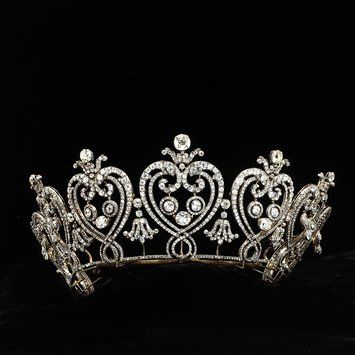
This is the Manchester Tiara, named for the Duchess of Manchester who commissioned it from Cartier in 1903--notice that the settings employ the newly-discovered metal platinum, which allowed Cartier to craft ethereal, almost weightless designs unknown in Princess Marie's day. The Duchess of Manchester who paid for this confection of platinum, diamonds, and--gasp!--glass, was none other than Consuelo Yznaga Montagu, Jennie's lifelong friend. Minnie had been genteely impoverished most of her life, but came into some cash after her brother's death. She supplied over a thousand brilliant-cut diamonds and 400 rose-cut diamonds to Cartier for the creation; the glass was used only on the tiara's ends, where it was fixed in Connie's hair. Cartier based the design of graduated hearts and C-scrolls on 18th century Paris ironwork. It was donated to HM Government in lieu of taxes and is now in the collections of the Victoria and Albert Museum.

And finally, those diamond stars--so beloved of Victorians, and identified with Jennie in particular. It turns out that it was Empress Elisabeth of Austria, known to her friends (Jennie and Charles included), as Sisi, who set the fashion in diamond stars. She loved them, wore them in her glorious hair for her Winterhalter portrait as a newly-married girl of sixteen, and when the Fashionable World took up her style with a frenzy--Sisi gave her diamond stars away to friends, as they were no longer special to herself alone. 

This is the greatest collection of stars I've found, a parure--meaning, a complete set of jewelry fashioned around the same theme, to be worn all OVER a woman's body. This is an 1870 suite comprised of a tiara, necklace, and a pair of earrings. Nestled in the blue velvet of its original jeweler's box from Collingwood & Son, it was auctioned at Christie's. Went for a mere $404,000 US dollars. Gaze at it and weep. 

For more images from THAT CHURCHILL WOMAN, visit the  Pinterest board behind the novel.